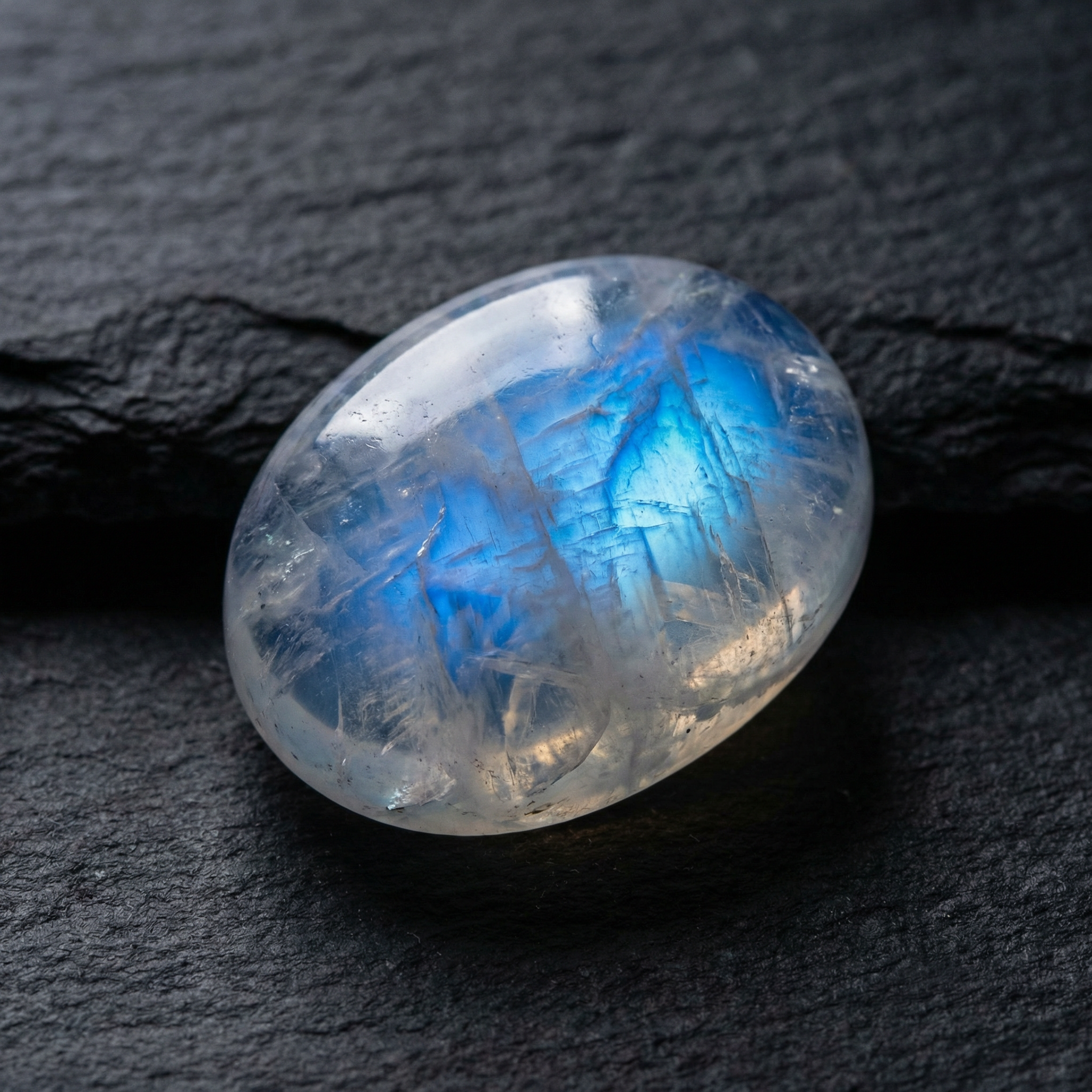
Moonstone (Feldspar)
Moonstone, a captivating gemstone from the feldspar group, is celebrated for its adularescence—a unique, billowy light that seems to float beneath its surface, reminiscent of moonlight. Revered since ancient times, it is associated with love, fertility, and intuition. Its ethereal beauty and deep-rooted symbolism make it a cherished stone in jewelry and spiritual practices, embodying a sense of mystery and romance.
Mohs Hardness
6.0-6.5
Origin
Sri Lanka, India, Madagascar, Myanmar, USA
Market Price Range
Commercial quality: $10-50 per carat. Fine quality with good transparency and blue sheen: $50-150 per carat. Exceptional stones over 5 carats can reach $200-500+ per carat.
Detailed Description
Identification Methods
Observe the adularescence; true moonstone exhibits a unique, mobile, billowy blue or white sheen that seems to float inside the stone.
Check for inclusions; natural moonstones often have tiny tension cracks known as 'centipedes'.
Test the hardness; at 6.0-6.5 on the Mohs scale, it can be scratched by harder materials like quartz.
Look for internal layering; the alternating layers of orthoclase and albite can sometimes be visible under magnification.
Beware of imitations; glass and chalcedony are common substitutes but lack the characteristic adularescence.
Market Information
The market for moonstone remains strong, particularly for high-quality stones with a strong blue adularescence. Prices have been steadily increasing due to demand from both traditional jewelry consumers and the spiritual wellness community. While smaller, commercial-grade stones are affordable, fine, large moonstones are rare and command high prices. The supply from classic sources like Sri Lanka is limited, adding to the value of top-tier specimens.
Classification
Feldspar (Orthoclase and Albite)
Curated selections with appraisal guarantee